Chapelton: a clock, a war memorial and an inland town’s public life
Location: Chapelton, Clarendon, Jamaica
Explore area in Google Maps ↗Map search for the named place or area. Arrange the actual entrance, guide meeting point and access with your host; this is not a confirmed tour departure.
An inland Clarendon landmark connects public time, local organising and remembrance of the First World War. Read the memorial before inventing a story from its shape.
A clock is a public decision
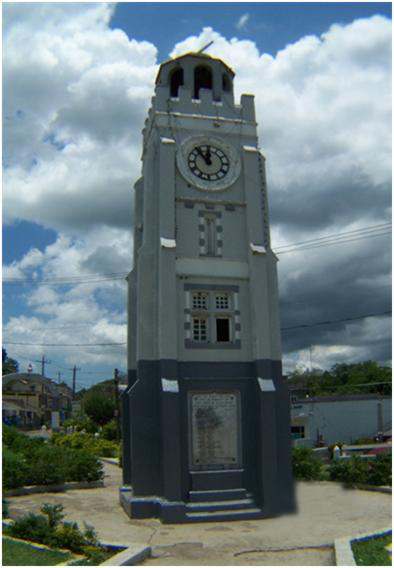
JNHT identifies the Chapelton tower as a war memorial and a prominent landmark in the town’s park. Its account names the Reverend E. E. Brice, a public meeting in May Pen and a committee formed to organise the memorial. That is a more useful beginning than admiring an old tower without asking how it came to be there. [1]
A clock visible in public space can organise appointments, journeys and the ordinary task of meeting somebody. A memorial asks for a different kind of attention. When the two share a structure, practical time and remembered time meet in the town’s daily life. This is an interpretation of the object’s roles, not a claim about how every resident has experienced it.
A distant war became part of an ordinary town day
A clock tower can be encountered without a deliberate memorial visit. Its presence in a town’s public space brings remembrance into the same setting as journeys, errands and meetings. The Chapelton memorial joined that everyday visibility to the effort to remember a war fought far beyond Jamaica.
The organising committee connects the structure to local action. People had to decide that the memory should take material form, gather support and create something the town would continue to see. The monument therefore tells two histories: the conflict it commemorates and the later community work of giving that conflict a place in Clarendon’s public life. [1]
Source & credit
Keep the town and the committee in view
The named committee links Chapelton with parish-level decision-making rather than a story confined to one benefactor. JNHT’s bibliography points to newspaper discussions in 1924 and 1925. Those references anchor the memorial’s planning history, but they should not be turned into an exact completion date without reading the underlying reports. [1]
A committee list also has limits. It identifies recognised organisers; it does not automatically identify every donor, mason, labourer or household contributing to the project. A fuller local history would set formal names beside the less visible work of financing, building and maintaining a public landmark.
A parish’s war remembrance is a local subject
JNHT’s national review includes the Chapelton tower among Jamaican First World War memorials. The local monument brings a distant conflict into Clarendon’s public landscape. Rather than assuming the people named all had the same service, birthplace or military role, begin with the inscription and then seek the record for each person. [2]
The difference between an inscription and a service file is productive. A memorial can show whom a community chose to remember; an individual record may explain when, where and in what capacity somebody served. Neither should replace the other. Family memory can add another perspective, provided it is identified as testimony rather than silently treated as a military register.
Remembrance can accumulate
The JNHT page also identifies a Cudjoe bust at the park. A war memorial and a Maroon leader’s memorial make different historical claims. Their proximity does not make them contemporary with one another or establish that every element was part of the tower’s original design. [1]
Read the park as a place where public memory can acquire new layers. Ask which object supplies its own date and which needs another source. This avoids the tempting but weak habit of treating an entire photographed scene as one event in the past.
An inland town was also part of a transport network
The Library’s railway chronology records a May Pen–Chapelton branch opening in 1913 and later closure of the May Pen–Frankfield line in 1974. Those dates introduce another dimension of public time: timetables, connections and a town’s relationship with places beyond it. They are a transport chronology, not proof of the tower’s founding date. [3]
A visit can hold both subjects together without overloading the day. Notice the memorial’s public setting, then read the railway story. The town becomes more than a charming stop: it is a place where people organised journeys, institutions and remembrance across changing generations.
Try the history yourself
Choose one inscription or named organiser. Make a note separating what the monument or JNHT page establishes from what a newspaper, service record or family account would need to establish. Do not fill a missing date with an architectural guess.
Make the visit fit the evidence
Plan a short, locally informed daytime Chapelton visit. Confirm park access, traffic crossings, seating, toilets and any guided interpretation. Allow 45–90 minutes as a planning estimate, with the actual transfer from your base kept separate.