Cinchona: the mountain garden built to test an agricultural future
Location: Cinchona Botanical Gardens, St. Andrew, Jamaica
Explore area in Google Maps ↗Map search for the named place or area. Arrange the actual entrance, guide meeting point and access with your host; this is not a confirmed tour departure.
High in St. Andrew, a botanical garden connects altitude, imported crops and colonial economic ambition. Its beauty becomes more interesting when we ask what it was established to do.
A garden above the ordinary plantation landscape
JNHT dates Cinchona’s establishment to 1868 and places it at roughly 4,500–5,500 feet above sea level. Altitude is part of the institution’s history, not merely a reason for a fine view. A mountain setting offered conditions different from the lowlands. The garden was therefore a place for asking which introduced plants might grow under particular conditions. Begin with that experimental purpose before treating the place as a scenic excursion. [1]
Elevation became part of an imperial experiment
A mountain garden was not simply a lowland garden placed higher up. Temperature and elevation made particular plants and experiments possible. Cinchona’s institutional story therefore belongs to efforts to turn Jamaica’s varied environments into useful botanical resources.
The present landscape also reflects the work required to establish and maintain a collection. Paths, specimens and buildings connect scientific ambition with labour on difficult terrain. Read beside Bath and Castleton, Cinchona shows a network of institutions testing different places and purposes. The mountain setting is beautiful, but the planted garden is also evidence of people trying to make environmental differences productive. [1]
Source & credit
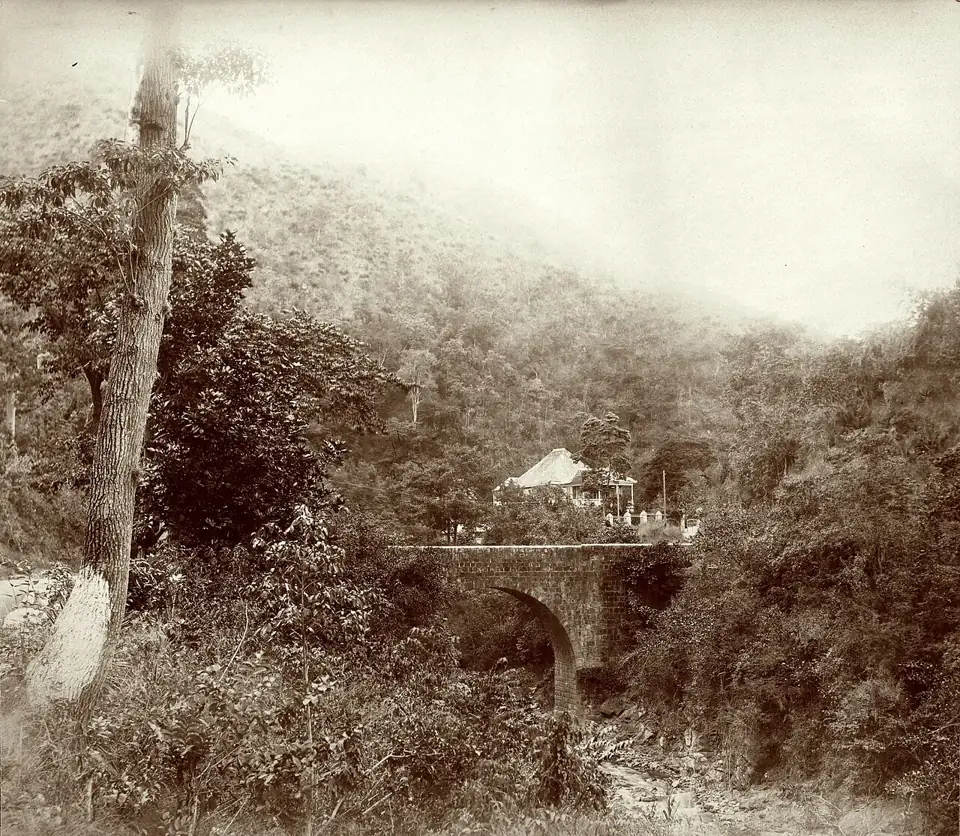
Look closely: This is a named mountain landscape elsewhere in St. Andrew, not the Cinchona garden. Compare slope, vegetation and settlement with the garden image; do not identify the buildings as Cinchona facilities.
Source & credit
Plants were part of an economic proposal
The Trust describes an effort to test Asian tea and European crops. That makes Cinchona an example of economic botany: plants collected and cultivated with hopes about production and trade. A trial plot is not proof of a successful export industry. The distinction between an intended crop, an experimental planting and an established commercial livelihood belongs at the centre of the story. Without it, a garden’s institutional ambitions can become a misleading account of what farmers actually produced. [1]
Who decided what counted as useful?
An official garden could classify some plants as promising and others as unproductive according to economic goals. Those judgments were made within a colonial administration and commercial world. Ask whose needs the experiments addressed: government revenue, export markets, estate owners, small farmers or local households. The short heritage account does not answer all of those questions. Its usefulness is that it supplies an institutional starting point from which annual reports and correspondence can be sought.
An experiment has a workforce
Gardens need propagation, soil preparation, watering, pruning, observation and the movement of supplies. These activities are easy to overlook when a source names administrators and crops but not gardeners. The photograph does not identify the people who built the terraces or maintained the collection. A fuller social history would investigate employment records and local accounts. Describe the labour as essential without inventing a roster, working conditions or a personal story for an unnamed figure.
Read the terraces as a managed landscape
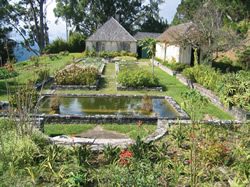
The source image shows a garden arranged on sloping ground, with planting, paths and buildings. That layout directs attention to the effort required to make a mountain site function as a collection and place of work. It does not show every earlier planting or establish which visible specimens belong to the nineteenth-century experiments. Write down what can be seen, then distinguish a modern view from the documentary evidence for the original programme.
Compare Cinchona with Bath Gardens
Bath’s earlier garden in St. Thomas and Cinchona’s mountain institution offer a productive local comparison. Their settings, dates and purposes differ. Make a table with altitude or setting, establishment date, stated crop interests and the source that supports each entry. Do not assume that a plant associated with one collection was grown at the other without a record. The comparison can show how botanical institutions responded to different environmental and administrative possibilities.
A mountain visit should deepen the story
On an arranged visit, look for interpretation that connects the surviving layout with the garden’s experimental past. Ask which plants are identified from historic records and which represent later additions. Notice how slopes, distance and maintenance affect the experience. A garden may retain its historical importance even when present conditions differ from an old photograph. A satisfying visit depends on confirmed arrangements, not on reading an undated opening schedule as a promise.
Follow an experiment through its records
Choose one crop explicitly named in the heritage account, such as tea. Build a research sequence: why was it proposed, where was it planted, how was performance recorded, and did the trial lead to wider cultivation? Leave unanswered stages blank. Then write a short account that distinguishes intention from result. This makes Cinchona an engaging story about knowledge and economic choices, rather than a list of plants or unsupported claims about medicinal benefits.