Folly: the mansion, the lighthouse and a story that outlived the evidence
Location: Folly Ruins, Port Antonio, Portland, Jamaica
Explore area in Google Maps ↗Map search for the named place or area. Arrange the actual entrance, guide meeting point and access with your host; this is not a confirmed tour departure.
A crumbling house near Port Antonio acquired a memorable marriage legend. The better story is what happens when photographs and dates interrupt a familiar tale.
A legend with a perfect ending
The familiar Folly story describes a wealthy American building an extravagant home for a young bride, only for the house to crumble and the wife to leave. Its emotional pattern is compelling: ambition, defective construction, rejection and ruin. But a story’s completeness is not evidence of its accuracy. The government’s Jamaica 55 account explicitly places this version beside a different documentary chronology. That contrast deserves to be the centre of the article, not a small disclaimer after repeating the legend. [1]
Source & credit
The dates change the marriage story
The Jamaica 55 account says the wife was already a grandmother on arrival in 1905, the husband died in 1912, and photographs from 1914 show continued residence. It places the roof’s collapse much later than the supposedly disastrous arrival. These selected details undermine the young-bride departure narrative. The household’s private conversations and motives remain undocumented in these accounts. [1]
Construction explanations need their own evidence
The same account presents salt water or sea sand corroding reinforcement as a believed explanation of deterioration. That is an attributed explanation, not a structural investigation reproduced here. A photograph can show damage but cannot by itself identify the chemistry of a building’s failure. To establish a technical cause, one would need construction records, material evidence and qualified analysis. The ruin remains interesting without pretending that a legend has supplied an engineering report. [1]
Examine the house before and after
The National Library’s digital collection supplies a historical view of the house and a separate photograph of the ruins by Brian J. Hudson in 1976. Open those records and compare visible rooflines, openings and the state of the walls. Keep their catalogues beside the images: the earlier view is not given a secure date here, while the later photograph has a named maker and year. Neither webpage’s upload date should become a date in the mansion’s history. [2] [3]
Examine the historical house view ↗ Compare the identified 1976 ruins photograph ↗
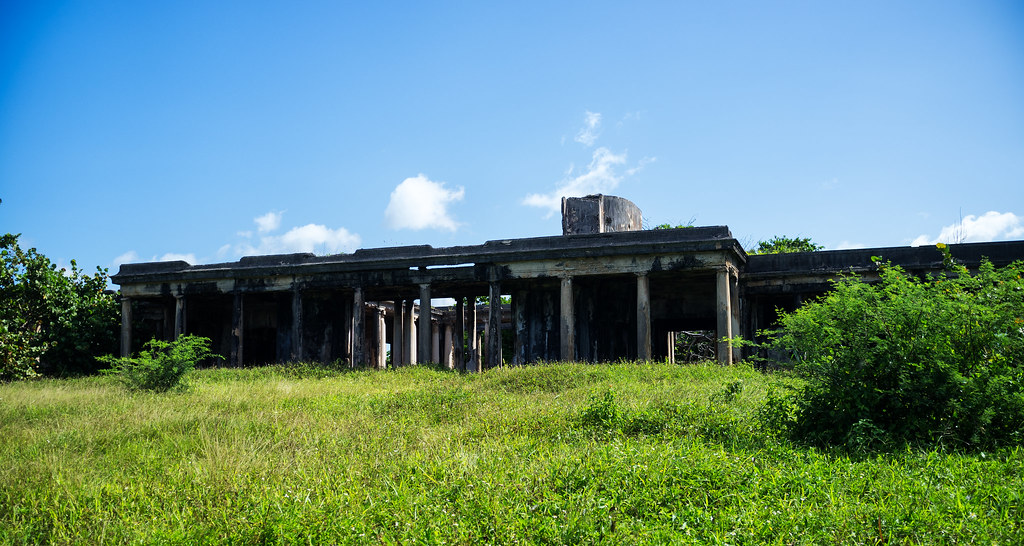
What the 2016 photograph actually shows
The mansion’s surviving columns and open upper edges are visible in nigel burgher’s dated photograph. Vegetation occupies the foreground and parts of the structure. Those observations support a description of a ruin at that time. They do not date its original collapse, establish why its materials failed, or show its condition after later storms. [6]
Compare this 2016 view with the Library’s earlier house image and Brian Hudson’s 1976 ruins record. Look for the roof and the relationship between columns and openings. The viewpoints and dates differ, so a feature outside one frame should not automatically be treated as missing from the building. Together, the records make the mansion itself visible while the nearby lighthouse supplies a separate coastal history.
A postcard’s approximate date is a clue, not a verdict
A Caribbean Photo Archive Flickr record labels another Folly view approximately 1900. Its catalogue date is approximate, and its rights statement does not make the image freely reusable. Read it as a research lead, not as automatic proof that the Jamaica 55 chronology is wrong. If two dates appear inconsistent, write down the wording and the uncertainty rather than quietly selecting whichever fits the preferred story. A historical postcard can circulate long after its image was made. [4]
Source & credit
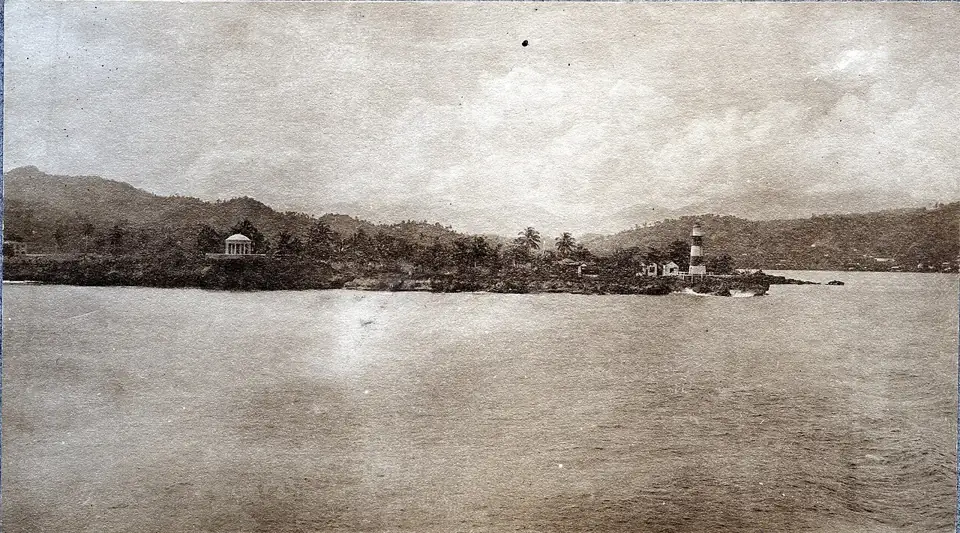
Look closely: Find the small lighthouse in the distant shoreline. This is not the Folly mansion and does not establish the story of its construction.
Do not confuse the house with the lighthouse
The 1905 waterfront photograph shows Folly Point lighthouse, which JNHT dates to 1888. It is a different structure with a different purpose. Keeping it separate helps a reader orient the locality without mistaking an attractive coastal tower for the ruined mansion. Compare it with Morant Point in St. Thomas: both relate to maritime movement, while Folly house belongs to residential ambition and later public storytelling. Proximity is not a shared construction history. [5]
Make the legend a learning exercise
Write two short accounts: first, what the legend claims; second, what the dated records actually support. Highlight the claims that require additional evidence. Then ask why the marriage story travels so well. Does it make a damaged building easier to remember? Does it supply a moral about wealth or imported ambition? Those are questions about storytelling, not proven explanations of the original household. This approach lets a lively local tale remain part of Portland’s culture without presenting it as settled biography.
Sources and notes
- Primary institutional account identified and attributed in the narrative. ↩
- National Library of Jamaica: historical Folly house image; date not established here. Open the record for its reproduction conditions. ↩
- National Library of Jamaica: Folly ruins, Brian J. Hudson, 1976, D0006939; reproduction permission required. ↩
- Caribbean Photo Archive on Flickr: Folly postcard, Raymond Brandon Collection, approximate catalogue date ca. 1900; all rights reserved. ↩
- JNHT: Folly Point lighthouse, Portland, built 1888; publisher of the inline photograph. ↩
- nigel burgher: Folly Ruins, taken 8 August 2016, uploaded 22 January 2017; primary Flickr page verifies CC BY 2.0. Capture date retained separately from upload date.