Spanish Town’s square: government, emancipation and the memory of empire
Location: Emancipation Square, Spanish Town, St. Catherine, Jamaica
Explore area in Google Maps ↗Map search for the named place or area. Arrange the actual entrance, guide meeting point and access with your host; this is not a confirmed tour departure.
Four sides of a civic square hold different forms of authority. Read the governor’s residence, assembly, court and naval memorial as a historical argument, not simply a collection of Georgian facades.
A square where authority met a crowd
On 1 August 1838, people gathered at Government House in Spanish Town for the proclamation ending apprenticeship. The National Library’s record of an illustration identifies a Baptist congregation’s procession to hear Governor Sir Lionel Smith. The event brought a crowd into the seat of colonial government. Its history belongs to the people marking freedom as well as to the official reading from the steps. [2]
Source & credit
The old capital was still changing
Spanish Town began as Villa de la Vega under Spanish rule and remained a centre of government after the English conquest. Kingston became the capital in 1872. The square’s Georgian buildings therefore belong to a long English colonial period layered onto an older town. JNHT dates the new King’s House to 1762, replacing a Spanish Hall of Audience demolished the previous year. [1]
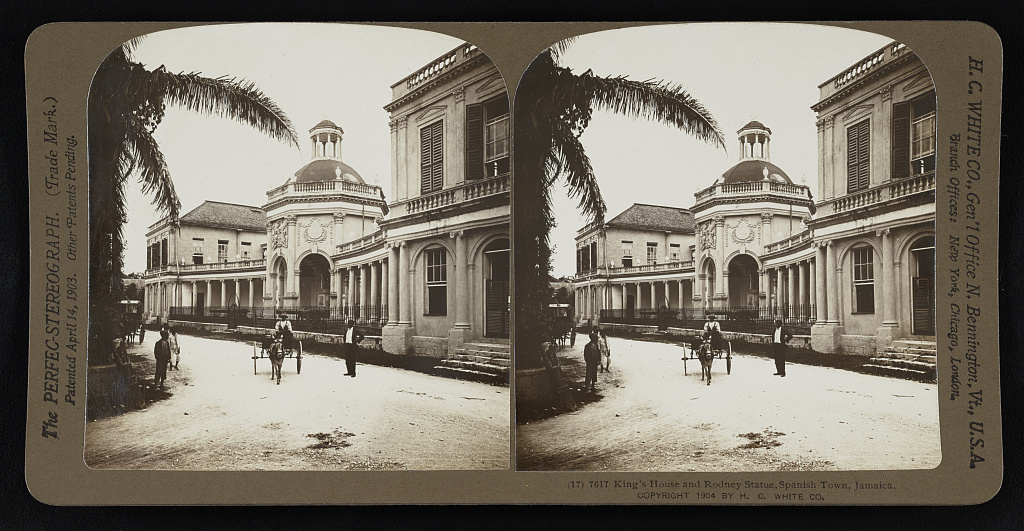
The 1904 stereograph shows an everyday street scene around the memorial and government buildings: pedestrians and a horse-drawn vehicle share the foreground. Its publication came after the capital’s transfer but before the 1925 fire at King’s House. That makes it a useful bridge between the administrative capital and the surviving facade in the later photograph. The two halves of the stereograph represent a paired optical view, not a before-and-after comparison. [3]
What changed in 1838
The proclamation marked the end of apprenticeship, the compulsory labour regime that had followed the 1834 Emancipation Act. The National Library’s transcription calls for thanksgiving in churches and chapels. Its accompanying history describes the disputes over compulsory work, subsistence and punishment that preceded full emancipation. [4]
That context changes the meaning of the steps. They were a stage for announcing a legal change won through a much wider struggle involving resistance, campaigning and testimony about abuses. The square gave freedom a public location; it did not give newly freed families a house, a plot or equal access to political power. Sligoville’s land purchases during apprenticeship show why the work of securing independence had already begun outside the governor’s residence.
Source & credit
Residence, legislature and court
The buildings organised different branches of colonial authority around a shared public space. JNHT places the Assembly building around 1762 and the courthouse in 1819. The governor’s residence was a home and official setting; the Assembly made laws; the court administered justice. Their proximity made the square a concentration of power, while access to that power remained unequal. [1]
A visitor can read the square across those relationships rather than treating each facade as a separate attraction. The emancipation announcement stands beside institutions that had sustained the earlier social order. That juxtaposition is part of the place’s force: profound change was proclaimed within the architecture of the government under which slavery had operated.
Whom a monument asks us to remember
Rodney’s memorial places a British naval commander in the civic landscape. The National Library identifies the victory it commemorates as the 1782 Battle of the Saintes. In the stereograph, the domed memorial commands attention while ordinary street users remain much smaller figures. [5]
The memorial invites comparison with Jamaica’s later monuments to people who challenged colonial domination. Each selects a person and an achievement for public honour. Looking from monument to residence to court gives the square several overlapping narratives: imperial victory, colonial administration, the proclamation of freedom and later decisions about national memory.
The fires are part of the history
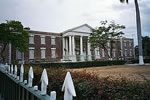
The later photograph shows a survivor of loss. JNHT records the 1925 King’s House fire and the courthouse fire in 1986. The buildings around the square did not survive as one intact eighteenth-century scene. [1]
Use the dated stereograph to notice what a later view can no longer show. Then follow the square’s story outward: to Sligoville for independent residence, to Sam Sharpe for resistance, and to Kingston for the movement of government and commerce. Together, those connections turn a group of impressive buildings into a history of who governed, who worked and how freedom became public.
Sources and notes
- JNHT, Spanish Town: civic-square building dates, capital transfer and the 1925 and 1986 fires. Historic account does not establish current access.
- NLJ, Abolition of slavery in Jamaica: catalogue description of the Baptist procession and 1 August 1838 proclamation. Record linked for evidence; its image is not reproduced here.
- Library of Congress, H. C. White Co., King’s house and Rodney Statue, Spanish Town, Jamaica: stereograph published/copyrighted 1904.
- NLJ History Notes, Emancipation Proclamation: transcription and explanation of apprenticeship. The institutional summary supplies context, not testimony from each participant.
- NLJ Rodney Memorial catalogue: Battle of the Saintes, 1782. See retained earlier source record for the monument identification.