Jamaican culture is social history you can hear
Songs, worship, speech and public performance are not colorful extras to the historical account. They record how people worked, mourned, judged conduct and made a place for themselves.
Before 1921: Dan Kildare and the Jamaican musician abroad
The recorded trail reaches back to 1914 through Kingston-born pianist Dan Kildare. Document Records identifies his work with Joan Sawyer’s Persian Garden Orchestra in New York and later ensembles in London. Mainspring’s collector discography dates the surviving Bregiero to 6 May 1914: Columbia A5572, matrix 36953–1. The record label credits Sawyer’s orchestra; the collector supports Kildare’s identification with contemporary press evidence. [Kildare]
Kildare widens the map. A Jamaican musician could work in an overseas dance orchestra long before the better-known Jamaican commercial genres. His presence does not make every composition or ensemble Jamaican, nor turn these discs into recordings of ordinary speech. These performances were made abroad; the 1921 examples below were recorded in Jamaica.
Listen, then compare: Identify the instruments and dance pulse you can actually hear in the 1914 selection. Then listen to Mrs Swabie and the Brown’s Town performers. What changes when music is recorded for a commercial dance audience rather than a field collection? Treat that as a question about setting and evidence, not a claim that one recording evolved directly into the other.
1921: begin with voices and instruments that were actually recorded
The Roberts and Beckwith cylinders let us start this musical history before the familiar commercial recording era. Indiana University’s public examples identify Mrs Swabie’s Jonkonnu song at Prospect, Watson’s Hill, and a fife-and-drum performance at Brown’s Town. They are recordings from 1921, not modern demonstrations of how an earlier tradition might have sounded. [1921]
First hear the singer as a person carrying a musical line. Repetition and phrasing give words a shape different from an interview answer. In the second sample, attend to how the melodic instrument and percussion occupy the same performance. These are listening tasks: describe a passage you actually hear rather than treating an old date as permission to declare an unchanged survival from slavery.
The cylinders also tell a history of collecting. A recording captures a selected occasion through a device with limits; its catalog supplies some names and localities while leaving others unnamed. That imbalance should affect the way we tell the story. Mrs Swabie belongs beside the collectors’ names. The unidentified instrumentalists belong in the account as performers, even where their biographies remain unavailable. The archive is part of the music’s later journey into research and public learning.
1931: Jamaican musicians also belonged to international jazz
Early Jamaican sound was not confined to one folk category. Frémeaux’s session notes list trumpeter Leslie Thompson on Spike Hughes Orchestra’s Tap Your Feet, recorded in London on 8 April 1931. Alpha Boys School Radio follows Thompson from Alpha Cottage School and military bands into his work in Britain, and provides another 1931 session example. These are music recordings rather than recordings of ordinary conversation. [1931]
This changes the shape of the wider narrative. Religious and community practices, dance-band work and jazz circulated through different settings. A country’s music history is richer when those settings coexist, rather than appearing as one genre obediently replacing another. Follow the people, places and performance tasks before drawing a connection between sounds. Musical training and movement can link local knowledge with an international ensemble without making every player or composition Jamaican.
Then return to the later mento, ska, rocksteady, reggae and dancehall discussions. Compare changes in ensemble, recording, amplification and audience. The 1921 examples are a documented early point from which to listen; they are not a complete acoustic reconstruction of the eighteenth century. The 1931 session is another route through the early twentieth century, connecting musicians with Britain. Together they make the history less dependent on a single commercial breakthrough date.
Tony’s Call: Hear the early recordings before naming the roots. Keep the singer, the instrumentalists and the traveling musician in the story; sound is carried by people.
The archive is larger than official paperwork
A property return tells us what an owner reported. A court book tells us what officials recorded. A song introduces another kind of account: an artist, ensemble or gathering gives a voice to relationships and experience. These sources differ in form and authority, but all belong to Jamaica’s history. Culture becomes more intelligible when it is placed inside the circumstances of work, family and public life.
Smithsonian Folkways’ Folk Music of Jamaica, released in 1956, places Kumina selections, work songs, ring play and Revival recordings in one collection. Its track list names groups and practices separately. Laborers singing with pickaxes are not the same performers or setting as a religious chorus. That distinction gives the collection historical value: it contains multiple social uses of sound rather than one generalized idea of “folk music.” [1]
Work had rhythm, but work was not only music
A work song can organize participation or accompany repetitive activity. Listening to the recorded pickaxe pieces makes the relationship between task and sound available in a way that a production total cannot. It does not establish every worker’s opinion of the job or turn hard labor into a cheerful scene. The musical account and the conditions of work need to remain together.
Louise Bennett’s Jamaican Folk Songs gives another perspective through an identified singer and folklorist performing work, dance and banana-loading songs. Her Linstead Market recording places Jamaican speech and performance at the center of a market story. The voice is not a neutral transcript of an unknown vendor, and the record is not a sample of everyone in Linstead. It is Bennett’s interpretation of a song whose social setting belongs to livelihood and exchange. [2]

Source & credit
Valentine and Sons’ view provides an earlier visual companion to the Linstead Market performance featured in this article.
Valentine & Sons · Public domain · Image record ↗A gathering could answer grief with participation
Ring games, Nine Night and Dinki Mini bring sound into relationships among households. Mourning can include companionship, story, food and lively participation; the gathering’s purpose explains why grief and humor need not be opposites. A family occasion and a staged performance do different work. JCDC’s folk-form categories preserve a public teaching and performance route, while the household setting belongs to another account. [3]
The same distinction applies to religious sound. Folkways labels Revival Zion choruses, prayer, groaning, blowing and cymbal selections, and identifies Kumina separately. These are not interchangeable expressions of a single belief. An institution’s historical description may use categories unfamiliar or objectionable to practitioners; a responsible article identifies the recorded form and explains the context rather than substituting a romantic label. [1]
Living heritage can enter new public settings
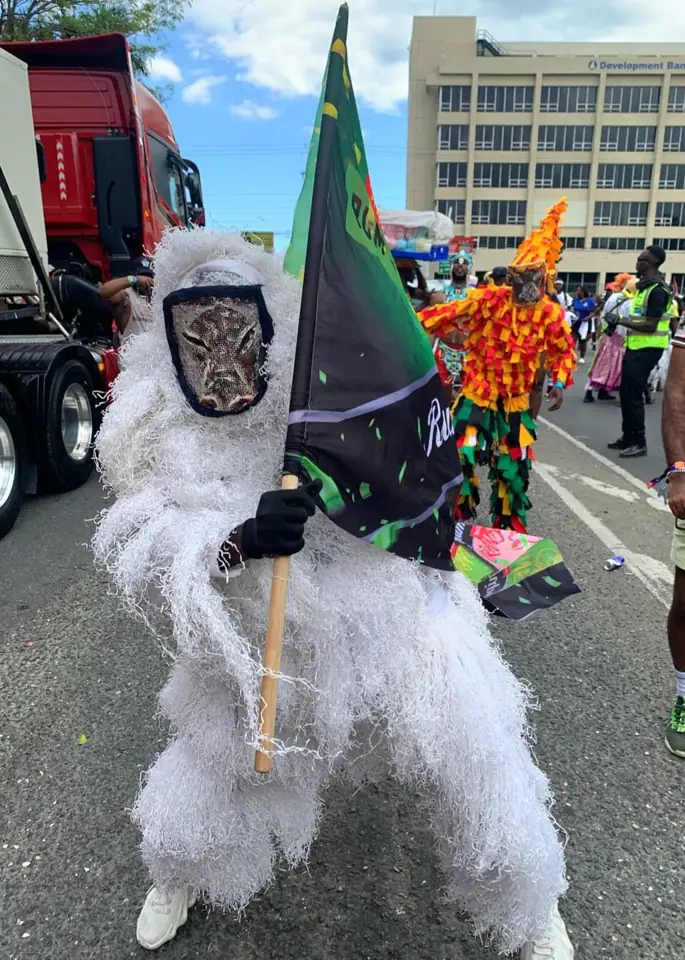
The 2025 photograph shows Jonkonnu characters in a Jamaica Carnival parade. It documents that appearance, not precisely how a Christmas gathering looked in the eighteenth century. A tradition can be carried into a new setting in which routes, spectators and cameras change the conditions of performance. Its present appearance becomes part of its history without proving that every detail has always remained the same.
Source & credit
The Seville Jubilee film supplies another kind of public event: modern remembrance of emancipation at a historically layered place. Read after the free-village and plantation articles, it connects a legal and material history to the ways people commemorate it now. The film belongs within the narrative, but is clearly distinguished from original footage of the period being remembered.
A recorded tradition is not the birth of a tradition
Commercial release dates tell us when a selected performance became available through a particular record. They do not date the first time Jamaicans sang, danced or played that form. The microphone also changes access: a sound can travel far from the people and occasion that gave it meaning. The artist’s name, community, title and collection notes are consequently part of the listening experience, not optional technical clutter.
The Drums of Defiance collection illustrates this well by identifying Moore Town and Accompong performers separately. Maroon music is therefore heard through named community performances, while the treaty article explains a different set of historical relationships. Neither music nor law can substitute for the other. Together they produce an account less vulnerable to the claim that a single recording or clause represents every Maroon person. [4]
Language carries judgment and authority
The everyday sound of kiss-teeth is another example of culture doing social work. Esther Figueroa and Peter Patrick analyze it as an interactional resource whose meaning depends on people, sequence and shared expectations, rather than a noise with one dictionary translation. A listener who reduces it to generic rudeness misses how conduct and relationships are being evaluated. [5]
Jamaica’s history can consequently be read in the small as well as the monumental: a repeated chorus, a market performance, a sound of judgment or a gathering around a household. The eight sound articles and the language feature develop those contexts on this page. The media is there to help readers notice relationships the prose explains, not to force them to reconstruct the history somewhere else.
Sound systems: equipment, labour and a later audience
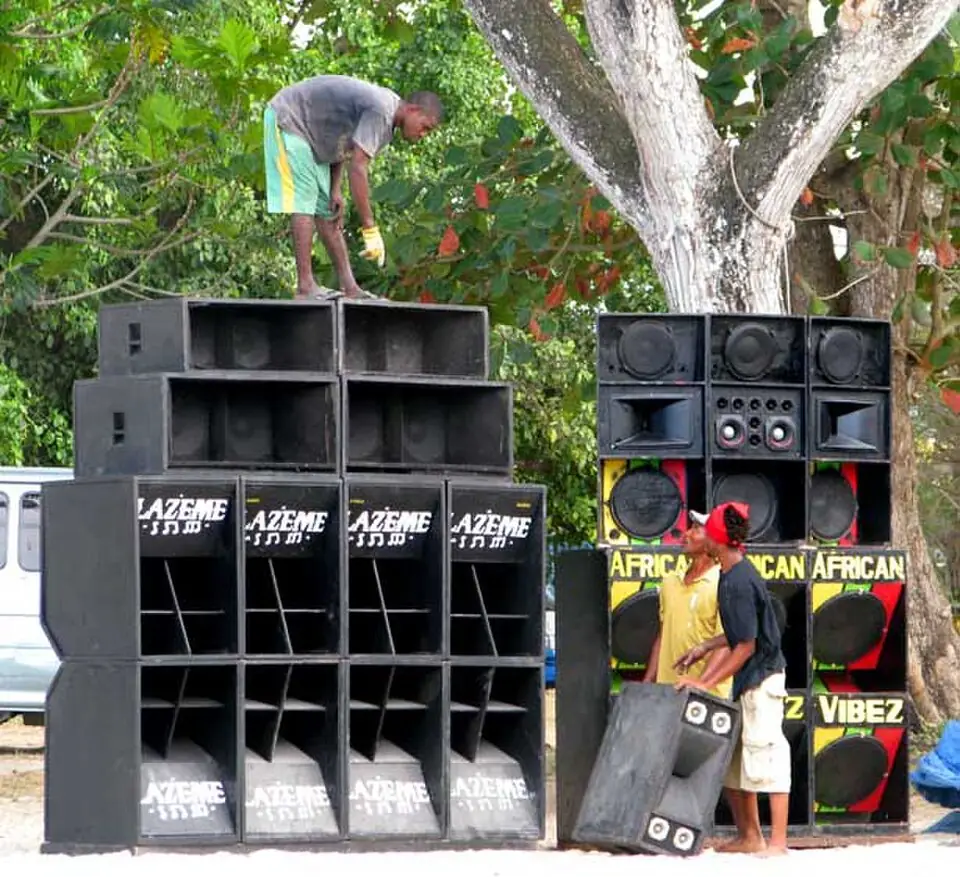
The early field recordings and the amplified performance below belong to different periods and occasions. This 2009 photograph shows people assembling a sound system in Negril. Use it to examine the work of moving and setting up equipment, then follow the sound-system and dancehall history.
Source & credit
Look closely: Notice the people lifting equipment and the separate speaker cabinets. A sound system requires material work as well as selecting music. This is a modern Negril scene, not a photograph of the first Kingston systems.
A recording preserves a relationship selected for recording
Work, worship, mourning and play give sound different purposes. The archive can place them beside one another on an album, but that arrangement does not make their original occasions equivalent. A work song belongs to labor; a religious performance belongs to belief and community; a ring game organizes another kind of participation.
Listen once for the sound and again for the relationship. Who starts a phrase, who answers and what does repetition make possible? Then read the supplied occasion and performer information. Those details change the interpretation more than attaching a broad “African influence” label to every track.
Public heritage presentation adds another chapter. It can preserve knowledge, teach an audience and create a performance career, while selecting material and changing duration. A staged excerpt is valuable evidence of that setting. Read Kumina, Ettu and Revival separately so that the distinct bearers, histories and purposes remain audible inside the wider Jamaican account.
Sources and notes
- Smithsonian Folkways. Folk Music of Jamaica (1956), FW04453: identified Kumina, work, ring-play and Revival recordings. ↩
- Smithsonian Folkways. Louise Bennett, Jamaican Folk Songs: work, dance and banana-loading songs. ↩
- Jamaica Cultural Development Commission. Traditional folk-form categories and public performance. ↩
- Smithsonian Folkways. Drums of Defiance: separately identified Moore Town and Accompong performances. ↩
- Esther Figueroa & Peter L. Patrick (2002). The Meaning of Kiss-teeth. University of Essex repository manuscript. ↩
- Document Records, Dan Kildare 1914–1917: Kingston birth, ensembles and recording context. Volume two: later Kildare recordings, 1917–1919. Mainspring Press collection: Bregiero, 6 May 1914, Columbia A5572, matrix 36953–1, with source-page audio. ↩
- Indiana University Libraries, Roberts and Beckwith Jamaica Collections: the two public 1921 examples, credited performers and localities. ↩
- Frémeaux & Associés, Jamaica Jazz 1931–1962: Tap Your Feet session, London, 8 April 1931. Alpha Boys School Radio, Leslie Thompson biography and separate 23 January 1931 session example. ↩