A market photograph and a song: Linstead, 1891
A photograph shows the gathering. A song gives us the seller’s predicament when the goods do not sell. Read them together and Linstead Market becomes a story about the household waiting beyond it.
The photograph has a place and a date
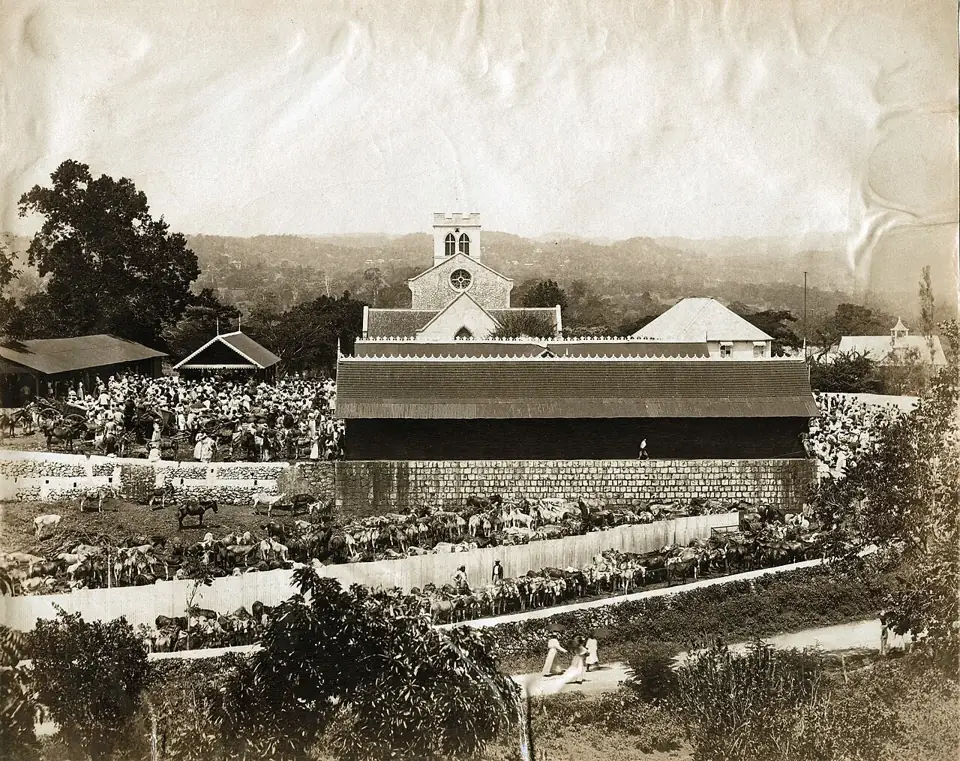
Valentine & Sons’ view is identified as Linstead Market in 1891. Begin with that specific object rather than a general image of “old Jamaica.” Its title locates the scene; its credit identifies the people who issued the photograph.
Source & credit
Look closely: Compare the town setting and crowded foreground with the 1891 Linstead image. These views of different markets show the trading world in which the song’s story belongs.

Source & credit
Read the photographed market alongside Miss Lou’s later song. The photograph and performance are different kinds of evidence about a named place.
Valentine & Sons · Public domain · Image record ↗Look for relationships
Examine where people stand or sit, how goods occupy the ground, and where movement through the market appears possible. Compare the scale of a person with the space around them. These are questions for close looking; the photograph does not supply every participant’s name or income.
The market belonged to a wider working day
Selling at a market connects several activities: producing or obtaining goods, carrying them, making a place to sell and returning afterwards. The image gives us one visible moment within those processes. The household-food article develops the larger relationship among labour, preparation and exchange.
Notice how the photograph directs attention. An image is framed from a chosen position and preserves one interval. People beyond that frame remain part of the historical market even though they cannot be recovered by magnifying the print. Close looking expands what we notice; it does not remove the limits of the object.
Hear another record of Linstead
The Mento Music Museum links Louise Bennett’s Linstead Market among its recordings. The performance connects the place to Jamaican language and song. Hear the rhythm and delivery, then return to the photograph: what can a voice carry that the silent image cannot?
[2]Two sources, one better question
The photograph and the song do not verify every detail in one another. Their value together is that they prompt us to examine both material arrangements and remembered experience. The market can be seen as a space and heard as a subject of performance.
Neither source makes the people anonymous ingredients in a picturesque national scene. Ask what work the market required, who performed it and how the place entered public memory. Some answers will need additional records; the paired media make the questions richer.
Follow food, carrying and household labour → · Hear more mento and quadrille →
The sale had consequences at home
The market photograph shows people assembled around goods. “Linstead Market” takes the story one step further: the seller has not sold enough, and the children’s needs give that failure its consequence. The song makes a relationship audible that a still photograph cannot show.
Put the two together and the market becomes more than a colourful stop. Cultivation, carrying and selling lead back into a household depending on the proceeds. The song’s speaker is not an identified woman in the 1891 photograph. One source records a gathering; the other gives memorable form to the risk carried into it. [1] [2]