The Maroon treaty: freedom negotiated inside a slave colony
The agreement of 1739 secured liberty and land for Cudjoe’s community. It also required the return of future fugitives. Both provisions belong at the center of the story.
Resistance made negotiation possible
By the time British representatives met Cudjoe near Trelawney Town, the colonial government faced communities it had not been able to reduce to ordinary plantation labor. Maroon settlement and resistance challenged the colony’s claim to control people, movement and territory. The treaty was a response to that conflict. Its opening describes years of hostilities; its first article ends them. Recognition did not originate in British generosity. It followed resistance strong enough to make an agreement preferable to continued war. [1]
The document names John Guthrie and Francis Sadler as the British negotiators and Cudjoe as the commander signing for his people. It is dated March 1, 1738–9, reflecting the older dating convention. Article two recognizes the liberty of Cudjoe, his captains and their adherents, while dealing separately with people who had joined them recently. Article three grants 1,500 acres between Trelawney Town and the Cockpits. The agreement therefore protected a defined community and territory; it did not emancipate Jamaica’s enslaved population. [1]
Land and livelihood came with supervision
Freedom had to include a way to live. The treaty permits cultivation of coffee, cocoa, ginger, tobacco and cotton, livestock raising and the sale of produce. These provisions recognize a community capable of farming and trade, rather than depicting the Maroons only as warriors. They also limit independence: produce taken to market required a license from a parish magistrate. Hunting was restricted near other settlements, and the community was expected to maintain roads connecting its territory to neighboring parishes. [1]
These arrangements brought autonomous settlement into an unequal relationship with the surrounding colonial economy. A community might control its land while relying on markets outside it; a road could facilitate exchange while also making movement more legible to government. The treaty also provided for white residents within the community and specified a succession of commanders, after which the governor would appoint leaders. This was negotiated recognition with channels of colonial oversight, not sovereignty without conditions.
The boundary between those protected and those returned
The most troubling obligation is explicit. Article nine requires future fugitives who came into Cudjoe’s hands to be delivered to the nearest chief magistrate. The confirming statute sets a payment of ten shillings for a return and directs the magistrate to arrange delivery to an owner or marshal. Human beings seeking escape were thus placed within an administrative chain of capture, payment and restoration to enslavement. Article six additionally obliges the community to help suppress other rebellions unless those rebels accepted comparable terms. [1]
The timing distinction matters. People who created communities through escape before the agreement were not in the same position as people escaping after it. From inside the recognized settlement, the bargain protected a collective achievement. From outside, it could close off a potential refuge. Violent colonial pressure helps explain why leaders accepted an agreement; it does not make the consequences for fugitives disappear. The document establishes the obligation. A history of its enforcement requires records of particular captures rather than an assumption that every clause was always obeyed.
There were more people in the story than the signatories
The confirming act also grants freedom to named people who assisted colonial forces: Cuffee, Sambo and Quashey, and two women, Venus and Affiba. Payments went to the people who claimed ownership of them. Their presence shows the colony using selective manumission to reward services and divide opposition. It also exposes the inequality of the settlement: a law could recognize one person’s liberty while compensating another for losing a property claim over that person. These people should not disappear behind the more familiar names of military leaders. [1]
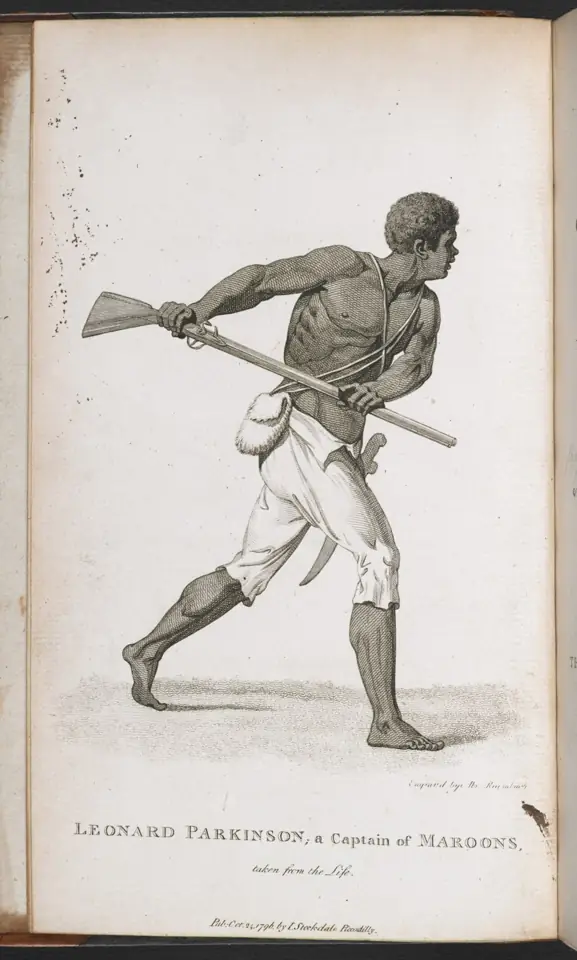
The later portrait of Leonard Parkinson belongs to another moment, the conflict of the 1790s. It is not a portrait of Cudjoe or a view of the 1739 negotiations. Similarly, contemporary Moore Town heritage belongs to a living community with its own institutions and knowledge. UNESCO describes communal treaty lands, local political organization, ceremonial practice and use of the abeng. The Accompong recording here and the Moore Town selection in its dedicated article identify different communities rather than offering one undifferentiated “Maroon sound.” [2] [3]
Source & credit
What this changes in the history of freedom
The treaty unsettles two easy stories. It contradicts the claim that the Maroons were simply defeated and given whatever the British chose to offer: resistance won meaningful concessions. It also contradicts the claim that recognition made the treaty communities universal protectors of everyone fleeing slavery. Some people gained security through obligations that helped preserve the system enslaving others. Jamaica’s history of freedom contains achievements, compromises and unequal boundaries at the same time.
That is the judgment to carry into a visit or a conversation: acknowledge the struggle, specify the community and the date, and keep the excluded fugitives in view. A proud account can withstand the treaty’s difficult clauses. An account that removes those clauses cannot explain how the colonial settlement actually worked.
Freedom must be read from more than one position
A treaty can be an achievement for one community and a restriction on another person's route to freedom. Keep those positions visible at the same time. Recognition, land and obligations appear in the document together; selecting only the celebratory clauses would change the agreement the reader is trying to understand.
The contrast is not a reason to deny the struggle that made negotiation possible. It is a reason to examine what a settlement secured, what it required and whom it left outside. Compare the treaty with Tacky's War for the later pressures on recognized communities within a colony that still enslaved people. Neither subject supports an account in which all Black participants had one political position.
For a heritage visit, separate the community's history from a tour's ability to explain every clause. Read the text first, then listen to the local account of remembrance and living identity. A present-day performance is evidence of transmission and community practice at its own date. It is not an audio recording of the eighteenth-century negotiation.
Sources and notes
- Jamaica Assembly (1739). Treaty with Cudjoe and confirming act. Acts of Assembly (1787), vol. 1, pp. 176–180. Full treaty clauses reproduced below. ↩
- UNESCO. Blue and John Crow Mountains: Maroon heritage, communal lands and the abeng. ↩
- Smithsonian Folkways. Drums of Defiance: separately identified Moore Town and Accompong performances. ↩
Read the fifteen treaty clauses here · 1 March 1738–9
Primary document: the agreement reproduced in the Jamaica Assembly’s confirming act, printed in Acts of Assembly, passed in the island of Jamaica, from the year 1681 to the year 1769 inclusive, volume 1 (Kingston: Alexander Aikman, 1787), pp. 176–180. The wording below was checked against the University of New Brunswick’s Laws of Enslavement and Freedom transcription. It preserves historical language and classifications; those are the document’s terms, not this guide’s descriptions of people. The university record returned restricted access in our direct link check, so the clauses are available on this page.
- That all hostilities shall cease on both sides for ever.
- That the said Captain Cudjoe, the rest of his Captains, adherents and men, shall be for ever hereafter in a perfect state of freedom and liberty, excepting those who have been taken by them, or fled to them within two years last past, if such are willing to return to their said masters and owners, with full pardon and indemnity from their said masters or owners for what is past. Provided always, That if they are not willing to return, they shall remain in subjection to Captain Cudjoe, and in friendship with us, according to the form and tenor of this treaty.
- That they shall enjoy and possess for themselves and posterity for ever, all the lands situate and lying between Trelawney town and the cockpits, to the amount of fifteen hundred acres, bearing north-west from the said Trelawney town.
- That they shall have liberty to plant the said lands with coffee, cocoa, ginger, tobacco and cotton, and to breed cattle, hogs, goats, or any other stock, and dispose of the produce or increase of the said commodities to the inhabitants of this island. Provided always, That when they bring the said commodities to market, they shall apply first to the Custos, or any other Magistrate of the respective parishes where they expose their goods to sale, for a licence to vend the same.
- That Captain Cudjoe, and all the Captain's adherents, and people now in subjection to him, shall all live together within the bounds of Trelawney town; and that they have liberty to hunt where they shall think fit, except within three miles of any settlement, crawl or pen. Provided always, That in case the hunters of Captain Cudjoe, and those of other settlements meet, then the hogs to be equally divided between both parties.
- That they said Captain Cudjoe, and his successors, do use their best endeavours to take, kill, suppress or destroy, either by themselves, or jointly with any other number of men commanded on that service by his Excellency the Governor or Commander in Chief for the time being, all rebels wheresoever they be throughout this island, unless they submit to the same terms of accommodation granted to Captain Cudjoe, and his successors.
- That in case this island be invaded by any foreign enemy, the said Captain Cudjoe, and his successors herein after named, or to be appointed, shall then, upon notice given, immediately repair to any place the Governor for the time being shall appoint, in order to repel the said invaders with his or their utmost force; and to submit to the orders of the Commander in Chief on that occasion.
- That if any white man shall do any manner of injury to Captain Cudjoe, his successors, or any of his or their people, they shall apply to any commanding Officer or Magistrate in the neighbourhood for justice; and in case Captain Cudjoe, or any of his people, shall do any injury to any white person, he shall submit himself, or delivery up such offenders to justice.
- That if any negroes shall hereafter run away from their masters or owners, and fall into Captain Cudjoe's hands, they shall immediately be sent back to the Chief Magistrate of the next parish where they are taken; and those that bring them are to be satisfied for their trouble, as the legislature shall appoint.
- That all negroes taken since the raising of this party by Captain Cudjoe's people, shall immediately be returned.
- That Captain Cudjoe, and his successors, shall wait on his Excellency, or the Commander in chief for the time being, every year, if thereunto required.
- That Captain Cudjoe, during his life, and the Captains succeeding him, shall have full power to inflict any punishment they think proper for crimes committed by their men among themselves (death only excepted) in which case, if the Captain thinks they deserve death, he shall be obliged to bring them before any Justice of the Peace, who shall order proceedings on their trial equal to those of other free negroes.
- That Captain Cudjoe with his people shall cut, clear, and keep open, large, and convenient roads from Trelawney town to Westmoreland and St. Jame's, and if possible to St. Elizabeth's.
- That two white men to be nominated by his Excellency, or the Commander in Chief for the time being, shall constantly live and reside with Captain Cudjoe and his successors, in order to maintain a friendly correspondence with the inhabitants of this Island.
- That Captain Cudjoe shall, during his life, be Chief Commander in Trelawney town, after his decease the command to devolve on his brother Captain Accompong; and in case of his decease, on his next brother Captain Johnny; and, failing him, Captain Cuffee shall succeed, who is to-be succeeded by Captain Quaw, and after all their demises, the Governor or Commander in Chief for the time being, shall appoint from time to time whom he thinks fit for that command.
The confirming act: section II directs a magistrate to pay ten shillings for a fugitive delivered by Cudjoe or people under his command and to arrange delivery onward to the owner or marshal. That payment provision is in the statute following the treaty; it should not be misquoted as the literal wording of article nine.