Stony Gut: the village behind Paul Bogle’s public life
Location: Stony Gut, St. Thomas, Jamaica
Explore area in Google Maps ↗Map search for the named place or area. Arrange the actual entrance, guide meeting point and access with your host; this is not a confirmed tour departure.
Begin in the village, not at the courthouse: congregation, land, collective action and the later work of remembering 1865.
Start where people organised
Morant Bay gives the uprising its familiar name. Stony Gut gives it a community. JNHT identifies the village as Paul Bogle’s home and the setting of his Baptist congregation. Its account also names Moses Bogle and describes the villagers’ journey to put grievances before Governor Edward Eyre. The important shift is from a solitary national hero to people acting through local relationships. [1]
A congregation could bring neighbours together repeatedly; a village could carry news, disagreement and decisions. Those are useful questions to bring to the history, rather than reasons to imagine a meeting for which we have no transcript. Bogle’s public role emerged in a lived landscape. The chapel was part of that landscape, but its presence does not tell us what every resident believed or how every decision was made.
Source & credit
Landownership did not remove injustice
JNHT’s fuller 2020 account presents Bogle as a baker, cultivator and landowner, not simply a man without resources. That complicates a familiar shortcut: poverty and protest do not require every participant to occupy the same social position. A person with standing in a community could still challenge the way courts and colonial authority treated neighbours. [2]
Keep the scale of any property claim separate from the underlying point. A later biographical summary is not the same thing as a deed, tax list or household inventory. The secure lesson here is that post-emancipation freedom had several dimensions: property, work, a voice in public affairs and fair treatment. Possessing one did not guarantee the others.
The village and the courthouse are different places
The institutional chronology places court confrontations in Morant Bay before the attempted arrest at Stony Gut and the march on 11 October 1865. That sequence connects the village and parish town without collapsing them into a single scene. The article’s dates are useful anchors; they do not supply a verbatim record of what people said along the road. [2]
When reading an account, mark where each action happened. Who was present in the courthouse? Who met the police in the village? A location change often signals a change in the people involved and the authority being exercised. The guide’s fuller Morant Bay article follows the wider uprising; this story keeps the community of origin in view.
Destruction is also part of the site’s history
JNHT’s account describes the targeting of the village and Bogle’s chapel during suppression, followed much later by a memorial garden. A present memorial therefore cannot be treated as an intact survival of the 1865 village. The difference between a surviving structure, a destroyed place and a commemorative marker belongs in the history itself. [2]
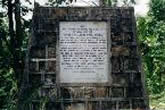
The photograph beside this story is evidence of later remembrance. It does not establish the appearance of Bogle’s house or chapel. That distinction matters especially when a photograph feels more immediate than a written account: visual clarity can make a later object seem older than it is.
A protected place is not a complete account
JNHT’s protected-sites inventory records Stony Gut’s declaration in 1992. Protection establishes an institutional commitment to a place; it does not settle every historical question or prove that a staffed visitor service is running today. Read the memorial, the designation and the historical account as different kinds of evidence. [3]
A good visit would leave you with a better question, not just a photograph of a marker. Which people are named? Which institutions appear? Which parts of ordinary village life are absent? A memorial can honour Bogle while leaving room for the histories of neighbours, women, children and livelihoods that need other records.
Try the history yourself
Make a three-column note: action, place, source. Enter the village organisation, the courthouse confrontation and the later memorial in separate rows. Then identify one question about ordinary Stony Gut households that these sources cannot answer.
Make the visit fit the evidence
Arrange a locally informed Stony Gut visit before leaving your southeastern base. Confirm lawful entry, guide availability, road approach, walking surfaces, seating and toilets. Allow 60–90 minutes for an agreed visit as a planning estimate; this is not a booked tour or a verified step-free route.