History Reconsidered | Morant Bay: After the Executions | St. Andrew and St. Thomas
George William Gordon: The Family Story That Did Not End at the Gallows
A mother-in-law’s letter dates the marriage, follows his sisters to Europe and records his support for his father. Gordon’s final letter brings his wife Lucy into the last hour of his life. Together, these documents restore a family to the National Hero.
Source & credit
In 1842, Mrs Shannon left Jamaica with a group of young women. Among them were George William Gordon’s two youngest sisters, twins whose schooling he paid for. An elder sister followed. Mrs Shannon took them to Paris, and Gordon travelled with her to bring them back. Her account, printed in 1867, restores a household of sisters, teachers, travel and obligations to a life usually told through politics and execution.
[4]Ann Rattray and Joseph Gordon
Gordon’s mother was Ann Rattray, an enslaved woman, and his father was Joseph Gordon, a Scottish planter and estate attorney. Historian Devon Dick names Ann and other children in his research into baptismal and slave-register records. Naming her changes the family story: Gordon’s beginnings belong to an enslaved mother’s household as well as to his father’s property and public position.
[7]Duncan Fletcher knew Gordon and members of his family. In his Personal Recollections, published two years after the execution, he describes Joseph as a native of Inverness and recalls speaking Gaelic with him at breakfast. He also writes of Gordon returning to his mother’s grave. The two parents occupy very different places in that account: one could converse with a visiting minister at his table; the other is remembered through her son’s mourning.
[4]Dick identifies an 1815 St. Andrew baptism entry for a three-month-old George Gordon at Cherry Gardens. His thesis gives the register reference, volume 2, page 53. This is the archival basis for the 1815 birth dating, rather than the circa-1820 date repeated in many biographies.
[6]The face beside the family story
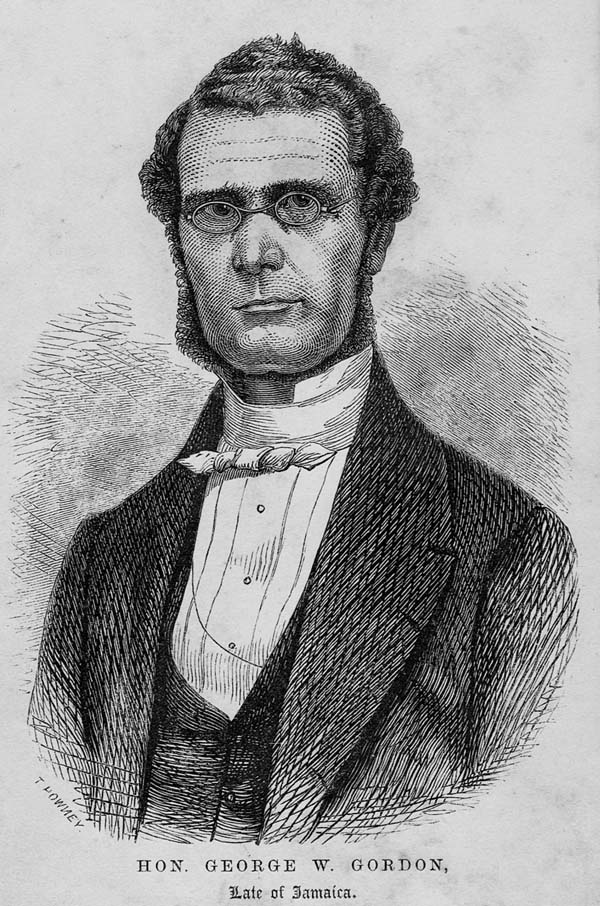
Princeton University Library identifies the following photograph as George William Gordon. It brings a photographic likeness into a story often illustrated only by the later engraving shown above.
[9]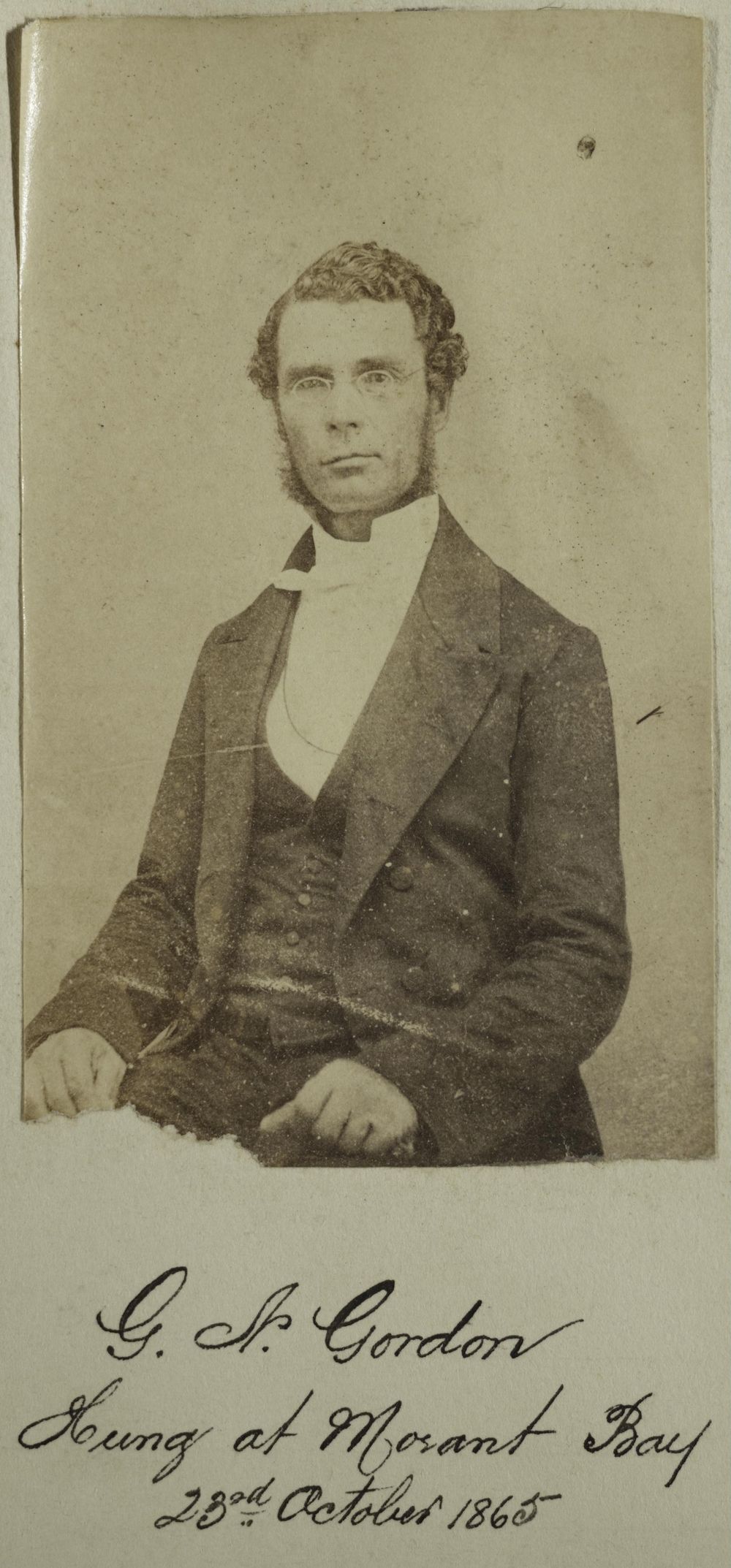
Source & credit
The sisters whose education he financed
Mrs Shannon’s letter supplies a dated sequence. She took the twins abroad in 1842; Gordon subsequently sent an elder sister. He paid their expenses and wanted them to spend time in Paris. In her account, the brother’s earnings supported an education that carried the sisters between Jamaica, Britain and France.
[4]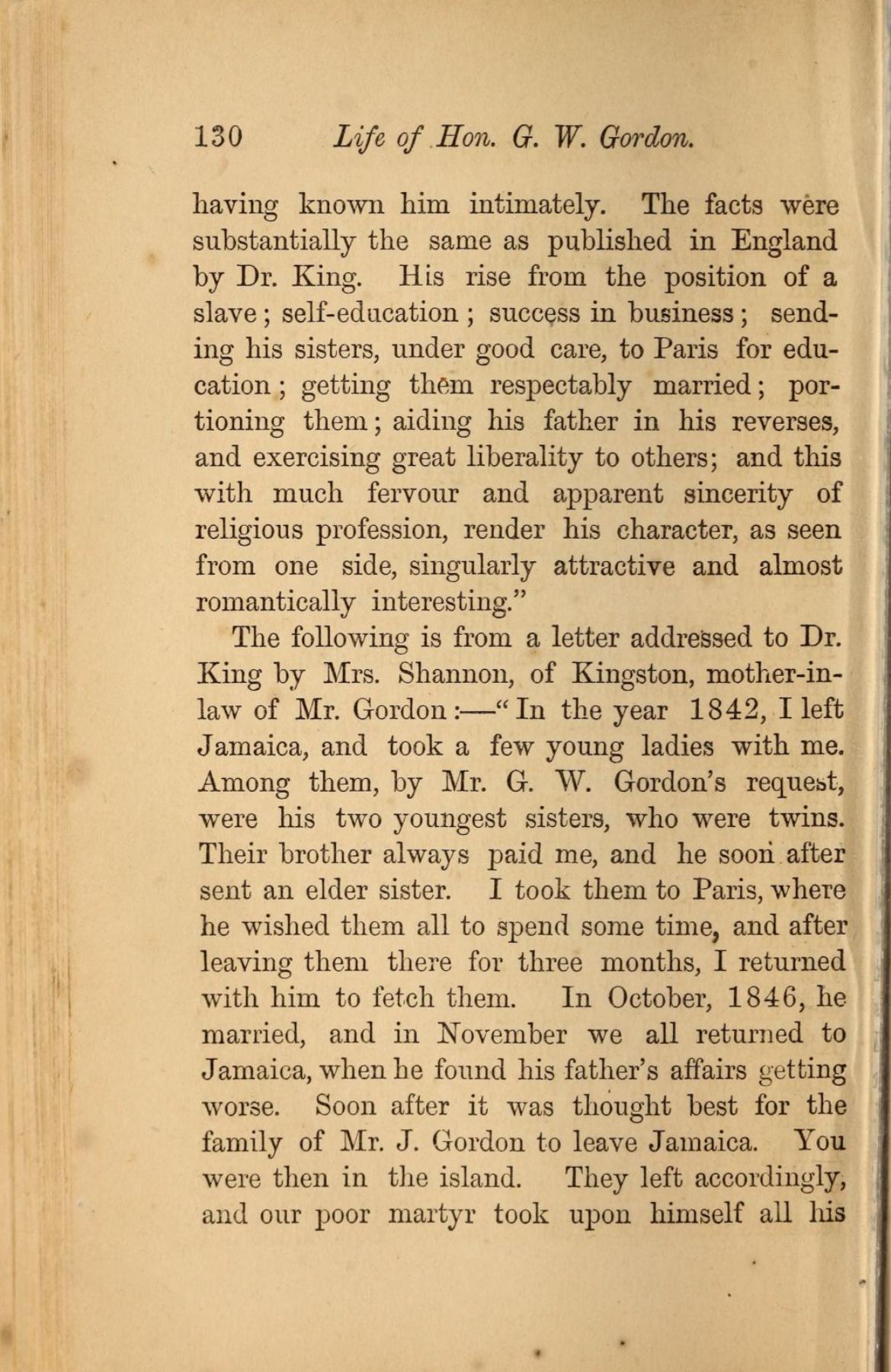
Source & credit
These journeys also reveal Mrs Shannon’s work. Fletcher describes her as the head of a Kingston school for girls and says he visited the institution. She was an educator and travelling guardian before she became the mother-in-law whose letter would help defend Gordon’s reputation after his death.
[4]Marriage in October 1846
“In October, 1846, he married,” Mrs Shannon writes. “In November we all returned to Jamaica.” Fletcher identifies Gordon’s wife as Miss Shannon of Kingston, born in France and educated in England, with an Irish father and an English mother. Gordon addressed her as Lucy; the footnote to his printed letter calls this his affectionate name for her. These family accounts establish a marriage and a household with considerably more substance than a name copied from an online tree.
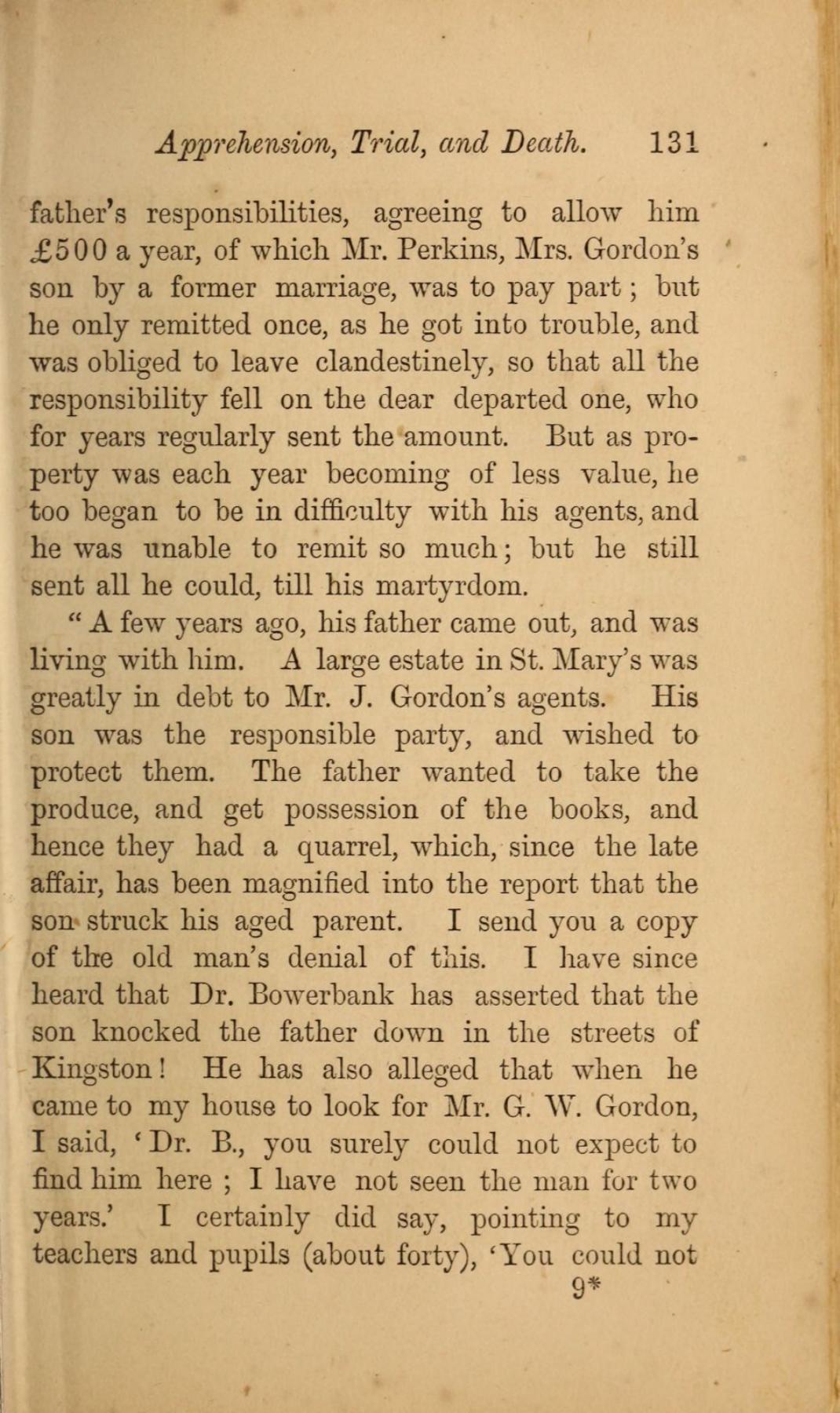
[4]The returning family encountered Joseph Gordon’s worsening finances. Mrs Shannon says George undertook an allowance of £500 a year for his father, carried responsibilities another contributor had failed to meet, and continued sending what he could when his own affairs became difficult. The successful son of an enslaved woman had become a financial support for his planter father.
[4]Read the continuation of Mrs Shannon’s letter: the £500 allowance
Source & credit
Fletcher’s account is openly sympathetic to Gordon. Its strength here is the concrete family testimony it preserves: who travelled, who paid, when the marriage occurred, and how obligations passed between generations.
Land, politics and the family’s exposure
Gordon became a businessman, landholder and elected legislator. The Jamaica Information Service records that he divided land into affordable farm lots and helped farmers market their produce. His criticism of Governor Edward John Eyre joined those practical efforts to a demand for fairer government. [1]
After the Morant Bay confrontation, Gordon was arrested in Kingston, outside the martial-law district, and transported to Morant Bay. He was tried by court martial and hanged on 23 October 1865. The controversy over that transfer and trial became central to the campaign against Eyre. For his household, it also meant the sudden loss of a husband, brother and financial supporter. [3]
“My beloved Lucy”: the household at the gallows
On 23 October 1865, Gordon wrote to Lucy after being told that his execution would take place within an hour. “I regret that my worldly affairs are so deranged,” he wrote, before protesting that he had neither advised nor taken part in an insurrection. Public injustice and private responsibility occupy the same page: he was defending his conduct while thinking about what his wife would inherit from his disrupted affairs.
[4] [5]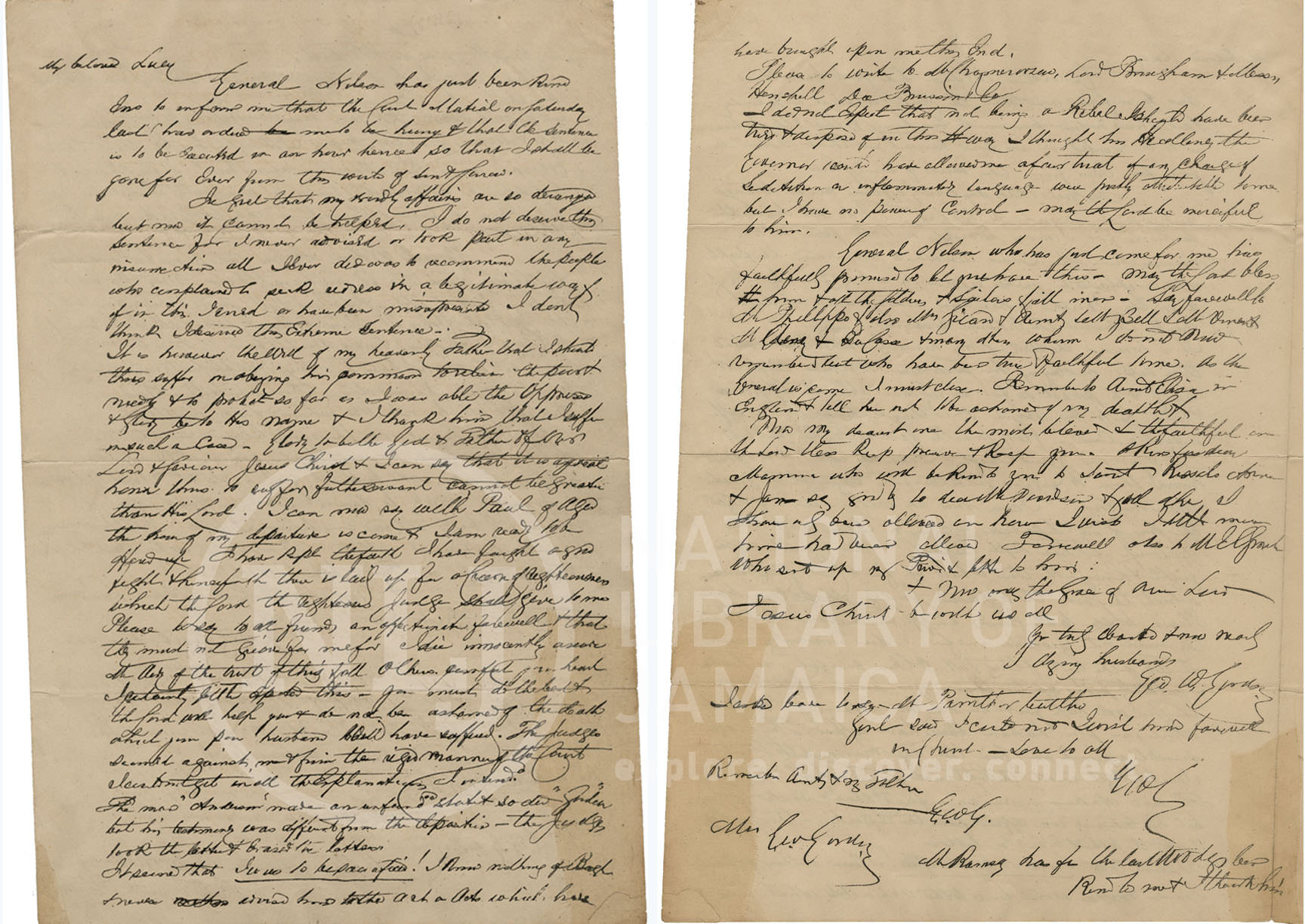
Source & credit
He asks Lucy to kiss Annie and Jane, remembers Janet, sends a farewell to Aunt Eliza in England, and ends with love to his aunt and father. These named farewells make the family network visible on the page. He signs as her devoted husband, “Geo. W. Gordon.” Lucy was the intended reader, and the people he asked her to remember were part of the world that continued after him.
Read the named farewells and signature in the early printed edition
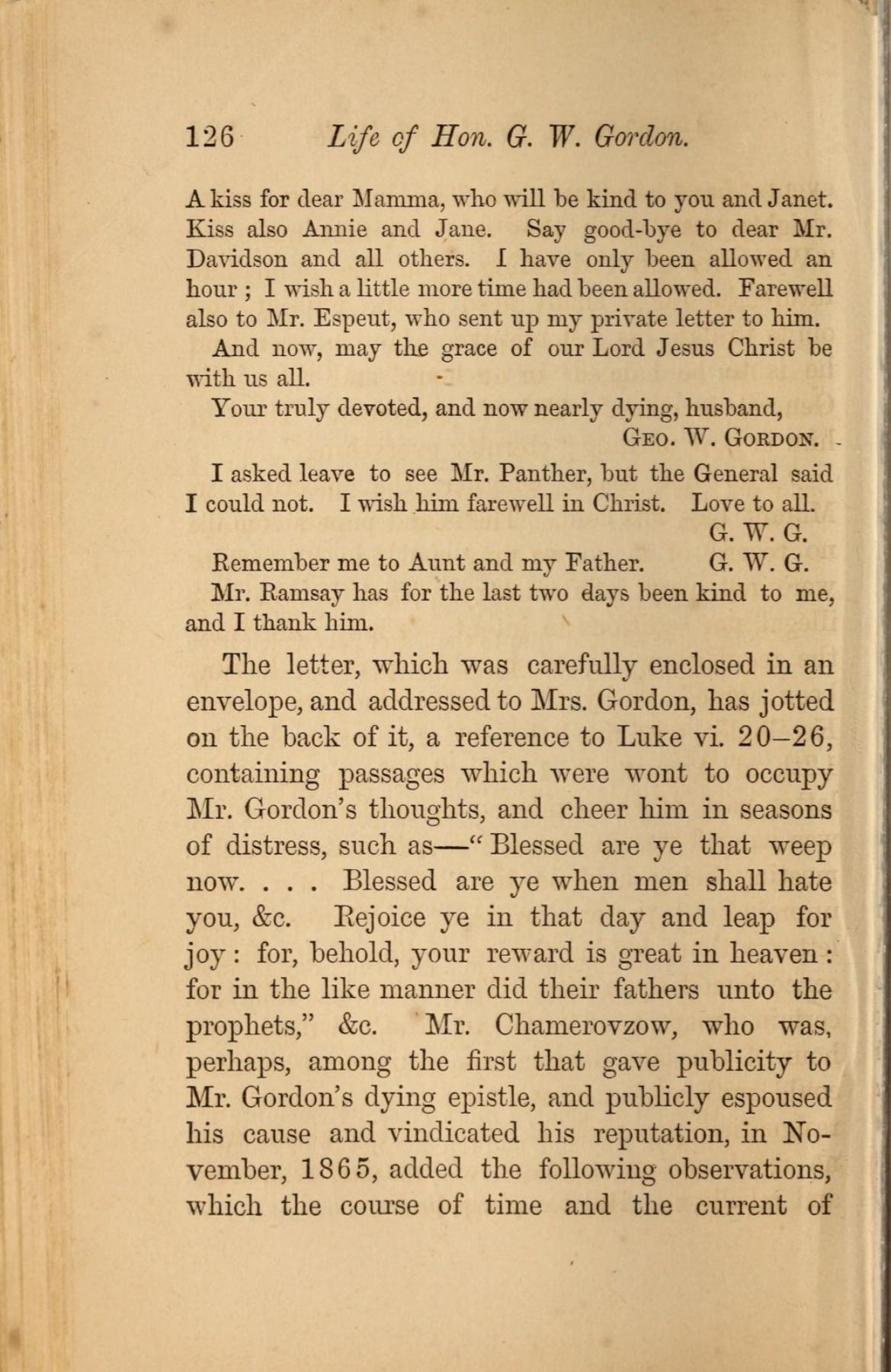
Source & credit
Property also continued to shape the family’s life. The Jamaica National Heritage Trust records that Oscar Marescaux bought Cherry Garden from Gordon’s widow in the late 1860s. The house’s later ownership links the familiar heritage landmark to a widow managing the aftermath of the execution.
[8]Edna Mae Gordon and the later family
A 2013 Jamaica Observer obituary identifies Edna Mae Gordon (1913–2013) as a direct descendant of the National Hero. It names her parents as Thomas Benjamin Gordon and Marie Ducat, and places her birth in Morant Bay. It follows a life through Jamaica, New York, New Jersey and Louisiana, including work in tobacco production and nursing.
[2]The reported descent gives the later family story names and places to follow. The remaining genealogical task is specific: establish Thomas Benjamin Gordon’s parents and connect that line to George William Gordon’s household. The obituary does not print those intervening generations.
That unfinished link should not obscure the family already visible in the earlier documents. Ann Rattray, Joseph Gordon, the sisters educated abroad, Mrs Shannon and Lucy belong to Gordon’s history in their own right. Their lives show how slavery, education, marriage, property and political violence met within one extended family.
Tony’s call: Read Gordon through the people for whom he paid, the woman to whom he wrote, and the family obligations he carried. The letters make those relationships visible beside the National Hero.
Explore the companion portrait essay: named officials and unnamed Jamaicans →
Sources and further reading
- Jamaica Information Service: George William Gordon
- Jamaica Observer: Edna Mae Gordon obituary, 28 December 2013
- Law and History Review: Re-Reading Morant Bay
- Duncan Fletcher, Personal Recollections of the Honourable George W. Gordon, Late of Jamaica (London: Elliot Stock, 1867). Library of Congress scan inspected: parents, pp. 15–16; sisters, pp. 29–32; household, pp. 38–45; letters to Lucy, pp. 124–126; Mrs Shannon’s letter to Dr King, pp. 130–134. An early memoir by an acquaintance and a printed reproduction of family correspondence.
- National Library of Jamaica: reproduction of Gordon’s last letter to Lucy. Manuscript image inspected alongside Fletcher’s early printed text. Letter written in 1865; reproduction published in 2017.
- Devon Merrick Dick, The Origin and Development of the Native Baptists in Jamaica and the Influence of their Biblical Hermeneutic on the 1865 Native Baptist War (PhD thesis, University of Warwick, 2008). Baptism citation, p. 45 note 11 and p. 177 note 329: St. Andrew Baptisms, Marriages, Burials 1807–1826, vol. 2, p. 53, 1B/11/8/1/2, Jamaica Archives. Thesis inspected; register image not yet inspected.
- Devon Dick, “Celebrate Ann Rattray, mother of a national hero,” The Gleaner, 31 October 2019. Research naming Ann Rattray and her children. Named slave-register entries remain to be examined directly.
- Jamaica National Heritage Trust: Cherry Garden Great House. Institutional account records the purchase from Gordon’s widow in the late 1860s.
- Julie L. Mellby, Princeton University Library Graphic Arts, 5 October 2009. Curatorial identification of the George William Gordon portrait. The album catalogue transcribes its initials as G. A. Gordon; the original inscription’s execution date is 23 October 1865.